

For years, talent acquisition has celebrated two primary metrics: time-to-fill and cost-per-hire. They’re easy to calculate, easy to benchmark, and easy to present in a quarterly slide deck. But while they measure efficiency, they can tell us almost nothing about effectiveness.
An organization can reduce time-to-fill by 30% and still make poor hiring decisions. It can reduce cost-per-hire and still experience high turnover, mediocre performance, and disengaged teams. In fact, over-optimizing for speed and savings often creates long-term damage that doesn’t show up until months later.
The uncomfortable reality is this: filling a role quickly is not the same as filling it well.
If hiring is one of the largest investments a company makes, shouldn’t we measure it by impact rather than activity?
The Problem With Efficiency Metrics
Efficiency metrics answer operational questions:
- How quickly did we close the requisition?
- How much did we spend to hire?
- How many interviews were conducted?
These are useful. They help manage workflow. They help forecast capacity. But they do not answer the executive-level question: Did this hire improve the business?
Time-to-fill is binary. The role is open, then it’s closed.
Cost-per-hire is arithmetic. Add expenses, divide by hires.
Quality of hire, however, is multidimensional. It unfolds over time. It reveals itself in performance reviews, project outcomes, team morale, and retention data. It cannot be measured at the offer stage.
When organizations focus primarily on efficiency, they inadvertently incentivize speed over discernment. We see this happen in all departments, not just HR: when speed is overprivileged, quality is sidetracked. If not, just take a look at your LinkedIn feed: it’s as if robots were talking to other robots (we have privileged speed over quality and now interesting thoughts have been replaced by GPT-nonsense).
How does this look with hiring? Well, interview processes shorten, screening becomes less rigorous, and hiring managers feel pressure to decide quickly. And while this may improve short-term reporting metrics, it often increases long-term volatility.
Define What “Quality” Actually Means for Your Organization
Before measuring the quality of hire, organizations must define what it means to them.
Quality is contextual. A “great hire” in a hyper-growth startup may look very different from a “great hire” in a regulated enterprise environment. Without alignment, measurement becomes arbitrary.
To define quality effectively, leadership teams should clarify the following:
Business Impact Expectations
- What measurable outcomes should this role influence?
- How does success in this position contribute to revenue, efficiency, innovation, or risk mitigation?
- At what point should a new hire be fully productive?
- What does meaningful contribution look like at 90 days, six months, and one year?
Retention Standards
- What is an acceptable tenure range for this role?
- Are turnover patterns signaling hiring misalignment or systemic management issues?
Cultural Contribution
- What behaviors reinforce company values?
- Does this role require collaboration, autonomy, leadership influence, or stability?
Future Potential
- Should this hire be capable of internal mobility?
- Does this role require collaboration, autonomy, leadership influence, or stability?
Defining quality requires collaboration between HR, finance, and operational leadership. When this definition is clear, metrics can be aligned to strategy rather than guesswork.
Redefining Quality of Hire as a Composite Index
All of this said, it is clear that quality of hire should not be treated as a single metric. It is better understood as a composite index, a combination of leading and lagging indicators that together reflect real impact.
Below are some recruiting metrics that many high-performing organizations use to evaluate hiring effectiveness more holistically:
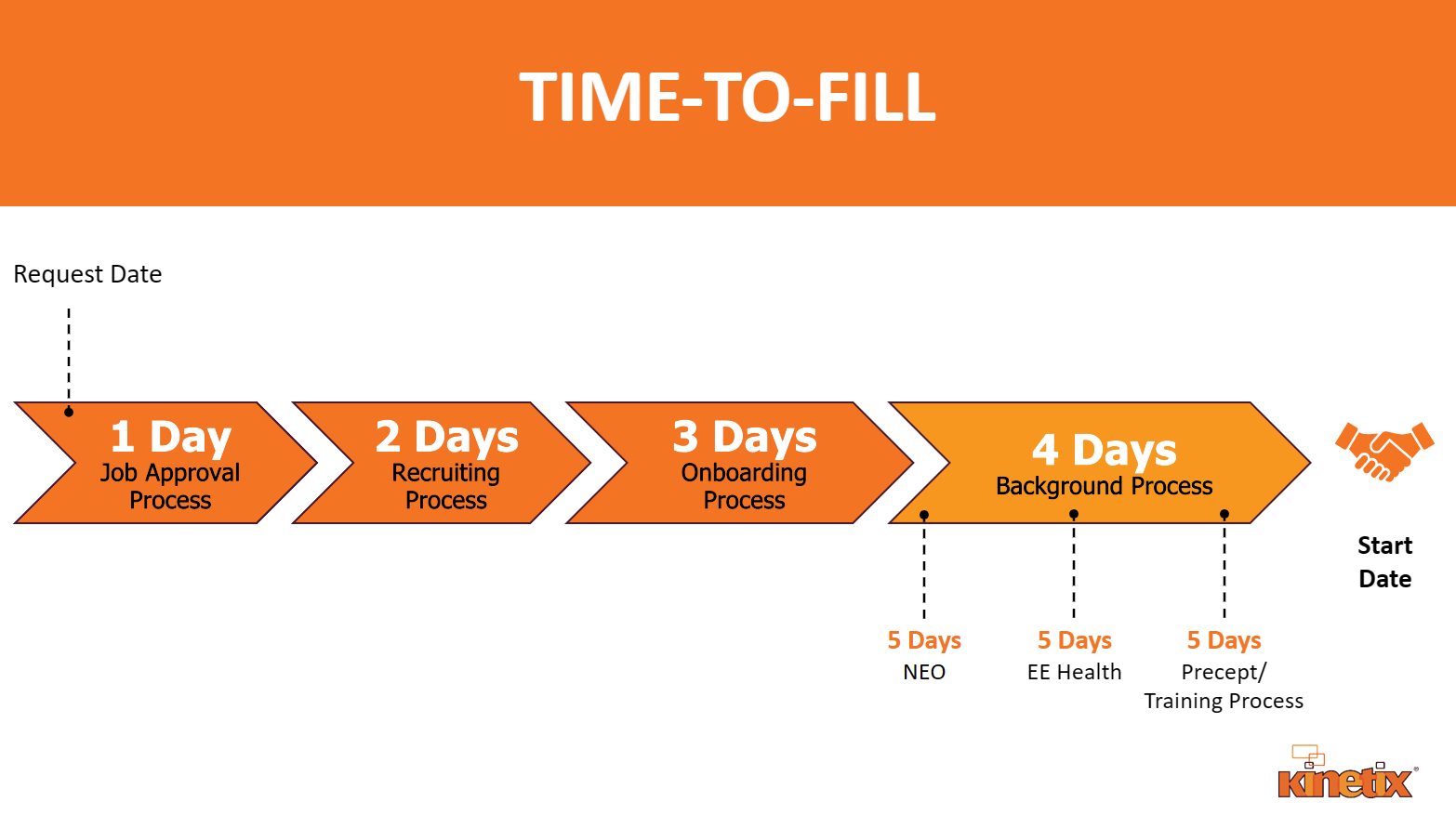
While efficiency metrics like time-to-fill track the speed of the hiring process, from requisition approval through recruiting, onboarding, and background checks, they only measure operational throughput, not the long-term value a hire delivers.
|
Dimension |
What It Measures |
Why It Matters |
|
Performance Outcomes |
KPI achievement, revenue impact, project delivery |
Direct contribution to business objectives |
|
Time-to- Productivity |
Speed at which new hire generates measurable value |
Reflects ramp efficiency and onboarding effectiveness |
|
Retention |
12–24 month turnover rates |
Signals alignment and long-term stability |
|
Engagement |
Participation, collaboration, feedback scores |
Indicates cultural contribution and team health |
|
Hiring Manager Satisfaction |
Evaluated at 6–12 months post-hire |
Captures real-world fit beyond first impressions |
Each of these dimensions captures a different layer of hiring success. Together, they form a more accurate picture than any single number could provide.
Performance Is the Anchor Metric
Of all quality dimensions, performance remains the most important.
A hire who meets or exceeds expectations at 90 days, 6 months, and one year is contributing tangible value. However, performance also should be contextualized. A high performer who leaves within a year creates disruption and replacement costs. Likewise, a technically strong hire who undermines team cohesion can create invisible cultural drag.
That is why performance data should not live exclusively within HR systems. It should feed back into recruiting strategy. Patterns should be analyzed:
- Which sourcing channels produce top performers?
- Which interview criteria correlate with long-term success?
- Which hiring managers consistently build high-performing teams?
Without this feedback loop, recruiting remains reactive rather than strategic.
The Hidden Cost of Ignoring Quality
When organizations fail to measure quality rigorously, the financial implications compound quietly.
Turnover within the first 12 months often costs between 50% and 400% of annual salary depending on role complexity. Beyond direct replacement expenses, there are opportunity costs: delayed projects, lost client trust, team morale erosion, and increased managerial bandwidth spent rehiring instead of leading.
Ironically, attempts to reduce cost-per-hire frequently increase total talent cost over time. Saving a few thousand dollars in recruiting fees is insignificant compared to the revenue lost from underperformance or early attrition.
Hiring is not an expense to be minimized. It is an investment to be optimized.
Recruitment Process Outsourcing
As hiring complexity increases, many organizations are re-evaluating internal capacity. This is where recruitment process outsourcing becomes strategic rather than tactical.
Modern RPO services are no longer limited to filling roles quickly. The most effective providers deliver integrated talent acquisition solutions that align recruiting with business performance goals.
When structured correctly, recruitment process outsourcing enables:
- Data-driven hiring analytics
- Standardized benchmarks
- Scalable recruiting infrastructure
- Continuous performance feedback loops
- Alignment with workforce planning strategy
- Scalable recruitment services
Unlike transactional recruiting, RPO partnerships often incorporate talent consulting, offering insight into workforce design, compensation competitiveness, and employer branding.
For organizations experiencing rapid growth or organizational transformation, this level of partnership supports long-term performance rather than short-term headcount targets.
The Executive-Level Question
Imagine that every hire made this year performed 20% better and stayed 18 months longer than average. What would that mean for revenue growth? For customer retention? For leadership focus? For culture?
And with these improvements comes something unmeasurable (and yet fundamental): everyone is happier (workers, managers, CEOs and investors).
That is the real leverage embedded within hiring strategy. Time-to-fill and cost-per-hire will always matter. They are operational guardrails. But they should never be mistaken for indicators of true success.
Quality of hire is not a vanity metric. It is a business multiplier.
Ready to move beyond transactional hiring metrics? Connect with Kinetix to get started today.